Visiting the Metropoliz Squatters in Rome
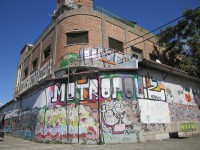 Rome A great adventure and advantage of my work is getting to see parts of a city that even long time residents cannot imagine. I may not see all of the sites in the tourist guide books, but I see amazing things where people live and work behind the walls of most visitors.
On arriving in Rome Saturday afternoon, Senator Lucio D’Ubaldo gave me a ride into the city since he was landing at roughly the same time. He insisted before visiting over lunch that I see some of the massive fascist architectural projects around the EUR district that had been largely abandoned with the advent of WWII, but were still deeply planted as governmental facilities in this very upscale Roman neighborhood. Being largely ignorant of these Mussolini-era projects, it was both fascinating, education, and almost frightening in its symbolic scale and ideological power.
David Tozzo of ACORN Italy and I had a different reaction on Sunday 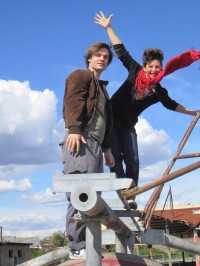 afternoon as we spent several hours touring “Metropoliz,” a “squat” and cultural project in a massive, former pig slaughterhouse in the eastern part of Rome. We had been introduced to this project through connections made with some of the volunteers helping ACORN International who were part of the graduate design and architectural projects at University of the City of London, and had promised to check it out during my visit.
About 100 people, who had been evicted or were homeless, were living permanently in Metropoliz. Immediately I could recognize Peruvians from my many visits to ACORN Peru, and seeing one section painted Peru Piazza only confirmed what I already knew. Other permanent squatters had come from Senegal and other countries as they were evicted from place to place. In a adjoining building were another 100 Roma who were not part of Metropoliz, but in the same soup. Over the two years of this experience various artists, designers, and others had joined forces with the squatters in a way that was not clear to me, but had evolved into a documentary film called Space Metropoliz. There was a large, homemade telescope at the top of the plant tower. A friend explained that three “balls” from the plant were imagined as the base and that they were working with the squatters on a p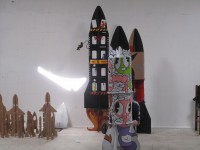 roject of “imagination” to build a rocket to the moon on top of that construct. I had some trouble following all of this, but perhaps that was the point, since the designers and cultural workers were trying an experiment to see if diverse people at Metropoliz could come together on an “act of imagination.” The film would document that effort.
Asking what would happen after the film was finished, I was told that that was a good question, which didn’t comfort me much. It seems that the future is also “part of the experiment” to see what the squatters will make of it all later when the film is over. I suppose that once again the rocket may hit earth with a loud and resounding thud.
Who knows? The space was mammoth, and in Italy access to water and lights are allowed for humanitarian reasons by the public utilities (amen to that!), so people were fashioning reasonable living quarters in some of the areas. Others were jumbles of graffiti and mayhem. The former “classroom” was little more than rubble with books thrown on the floor. The most finished area was where the “rockets” were being painted by professional artists and some of the children.
As we were walked around on a gorgeous Sunday afternoon with a breeze in the air and the first hint of fall everywhere, we could tell by the steady stream of people who seemed to be going and coming that Metropoliz was something of a happening. The permanent squatters were sanguine about all of that and largely ignored the outsiders and their trooping around cameras in hand. This was not industrial tourism but a sort of “developmental tourism” almost similar to what we had seen in the recycling area of Cairo.
Ther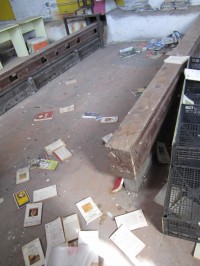 e seemed to be potential everywhere, but problems almost as large. According to our friends from UCL, this is one of a number of similar squats around Rome. It’s an interesting phenomena and worth a look. I’m skeptical about how all of this plays out, but was filled with good wishes and hope for all involved. Why not? Something good can happen here that wasn’t possible before hand.
shareshareshareshareshareshareshareshare


 Rome With hustle and grit, David Tozzo, our intrepid volunteer organizer in Rome, had secured a free office for ACORN Italy in a community center of sorts called Case de la Quartier…the House of the Quarter. Most of our beginning work is in the 4th Quarter, the largest of the 19 quarters or districts with 350,000 residents. We finally kicked off our meeting in the basement of the office with the first 20 people and gradually as the meeting went on the number rose to 30 or so. Not only were we introducing ACORN International and ACORN Italy to some new people, but we were also moving forward on our campaign to win rent reductions for tenants with unregistered contracts where a new national law is a tool in breaking down the black market.
 In the cutthroat “jungle” of housing shortages, landlord tax evasions, and a tight market in apartments for students, the poor, and many others, frequently landlords are renting simple rooms on the black market for 500 euros. The new law allows tenants to turn in their landlords if they have an unregistered “leases” and win huge reductions of up to 90% of their rent and have that amount frozen for 8 years on the lease and options. Furthermore, since the state designed this law to catch tax evasion, it also forbids the landlords escaping the penalty by selling the aprtment, since in effect they are paying back the tenants they exploited, rather than the government they cheated. Amazing!
 Earlier I found myself meeting with a mayor of a small suburban town on the outskirts of Rome and several young and coming political figures at the grassroots basis at a superb lunch with excellent conversation thanks to Lucio D’Ubaldo, an elected Senator and publisher of a monthly political magazine, who also happened to be the co-author of a book on the correspondence between the French philosopher Maritain and Saul Alinsky. He and our firecracker, David Tozzo, have a volume coming out next year discussing Alinsky and community organizing, and no doubt I owe Saul thanks after 40 years for this connection – a gift that keeps giving!
 partially judge this as I see so many veterans of our work in community organizing joining the lists. There was Helene O’Brien, ACORN’s former field director, in the bottom left hand corner of the New York Times picture from Occupy New Orleans yesterday. My offer of meeting space at Fair Grinds is being welcomed. All of our folks in New Orleans were in the march. Dewey Armstrong from ACORN in the late 70’s and 80’s sent me his thoughts on having attended the organizing meetings of Occupy Miami. Ex-ACORN state operations are widely reported as involved in New York, California, and Massachusetts. Craig Robbins from Citizens United in Philadelphia reached out to say how interesting it looked in his state and how close he was following the activity. John Anderson in Vancouver couldn’t control his frustration at the disorganization of Occupy there, but was definitely in the room during the planning.
 COS’E’ ACORN? . ACORN Italy fa parte della più grande federazione mondiale di “organizzazione di comunità”, ACORN International, fondata negli anni ’40 negli USA da Saul Alinsky. Un ibrido fra un’associazione per i diritti civili e una piattaforma di attivisti che mobilita le comunità, Acorn spinge la cittadinanza ad attivarsi per affrontare qualsiasi problema comune, dall’ingiustizia sociale all’illegalità.